International Flight Delay Rights: EU261 vs Montreal Convention
Which passenger rights apply to your international flight depends on your route and airline. Here's when you're covered by EU261, Montreal Convention, or U.S. rules.
Save it in this browser to find it later.
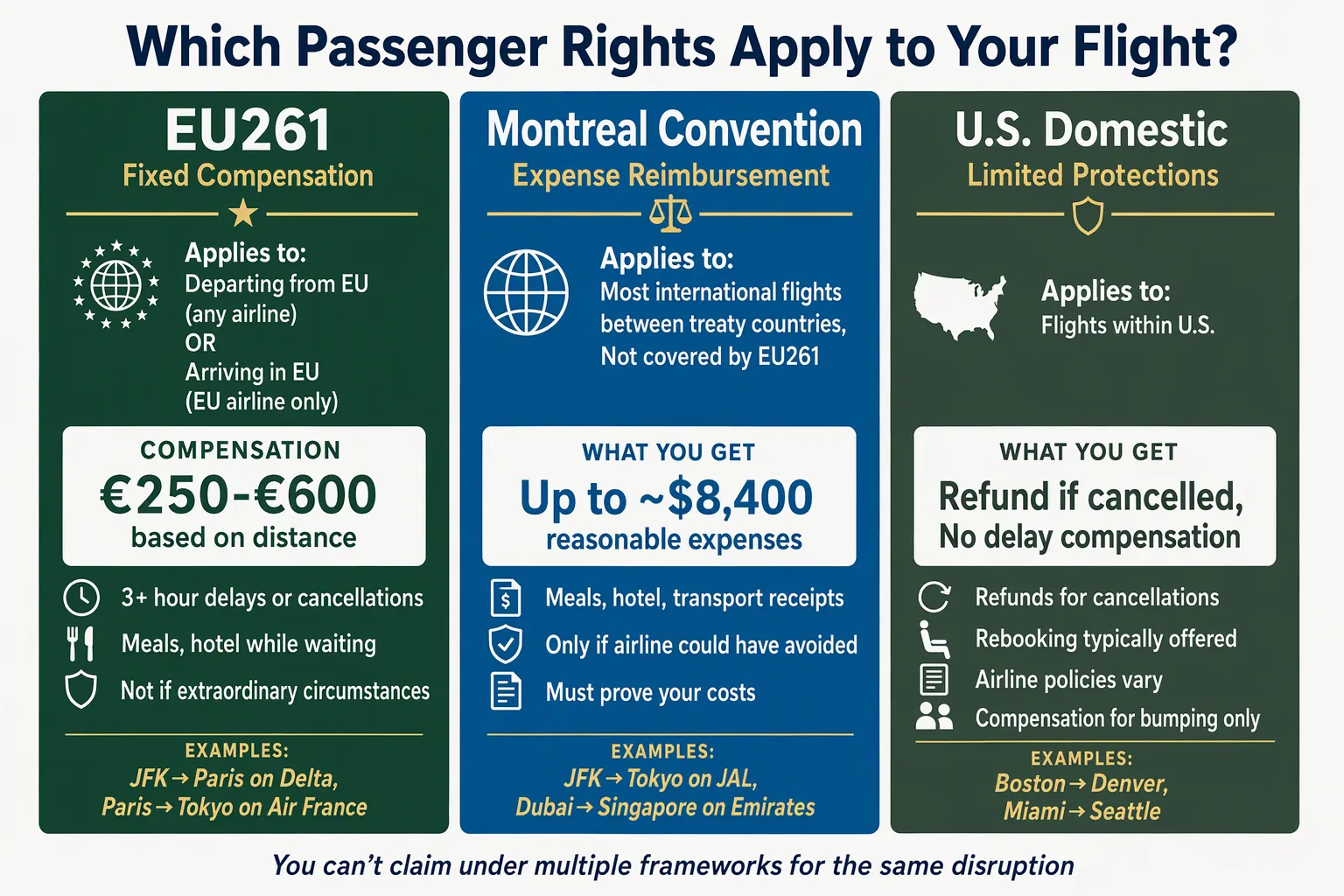
Which passenger rights apply to your international flight depends on where you're flying and which airline operates it. Flights departing the EU or arriving in the EU on an EU airline are covered by EU261, which provides fixed compensation of €250 to €600 for delays over three hours or cancellations. Most other international flights fall under the Montreal Convention, which lets you claim reimbursement for reasonable expenses the airline caused, up to about $8,400 per passenger. These protections are broader than U.S. domestic flight rules, which don't require compensation for delays or cancellations.
When EU261 applies to your flight
EU Regulation 261/2004 (EU261) covers you if:
- Your flight departs from any EU airport (on any airline)
- Your flight arrives at an EU airport from outside the EU and is operated by an EU airline
- Your flight is within the EU
The EU includes all 27 member countries plus Iceland, Norway, and Switzerland. Your nationality doesn't matter—these rights apply to anyone on a covered flight.
EU261 does not apply if you're flying from outside the EU to the EU on a non-EU airline. A flight from New York to Paris on Delta is covered; the same route on Air France is covered; on Emirates, it's not.
What EU261 gives you
Fixed compensation amounts
If your flight is delayed three hours or more at arrival, or cancelled less than 14 days before departure, you're entitled to compensation unless the airline proves the disruption was caused by extraordinary circumstances (severe weather, air traffic control strikes, security threats).
Compensation depends on distance and delay:
| Distance | Delay at arrival | Compensation |
|---|---|---|
| 1,500 km or less | 3 hours or more | €250 |
| 1,500–3,500 km within EU | 3 hours or more | €400 |
| Over 3,500 km | 3 hours but less than 4 | €300 |
| Over 3,500 km | 4 hours or more | €600 |
These are the amounts as of 2026, from Your Europe.
Care and assistance while you wait
Regardless of what caused the delay, the airline must provide:
- Meals and drinks based on the wait time
- Two phone calls, texts or emails
- Hotel accommodation if the delay runs overnight, plus transport between the airport and hotel
You're entitled to this care at:
- Two hours for flights under 1,500 km
- Three hours for EU flights over 1,500 km or other flights 1,500–3,500 km
- Four hours for flights over 3,500 km
If the airline doesn't offer assistance and you pay for meals or a hotel yourself, keep receipts and claim reimbursement for necessary, reasonable expenses.
Your choice after cancellation
If your flight is cancelled, the airline must offer you a choice between a full refund, rebooking on the next available flight, or rebooking at a later date that works for you (subject to seat availability).
When the Montreal Convention applies
The Montreal Convention is an international treaty that most countries have signed, covering nearly all international air travel. It applies to flights between countries that are parties to the convention—which includes the United States, Canada, most of Europe, and over 130 other countries.
If your flight isn't covered by EU261, the Montreal Convention likely is. It covers flights between treaty countries but operates differently from EU261.
What the Montreal Convention gives you
The Montreal Convention makes airlines liable for damage caused by delay, up to 6,303 Special Drawing Rights (SDRs) per passenger—about $8,400 USD as of late 2024, according to ICAO. This limit is reviewed every five years to adjust for inflation.
Reimbursement for reasonable expenses
Unlike EU261's fixed amounts, the Montreal Convention lets you claim reimbursement for actual costs you incurred because of the delay: meals, hotel, ground transport, rebooking fees. You need to show:
- The delay was caused by something the airline could reasonably have avoided (mechanical problems, staffing issues, operational mistakes)
- Your expenses were necessary, reasonable, and appropriate
- Receipts for what you spent
If the delay was caused by something outside the airline's control—severe weather, air traffic restrictions, security threats—the airline typically isn't liable under the Montreal Convention. Your options then depend on the airline's policies and your ticket terms.
Not fixed compensation
The Montreal Convention doesn't guarantee a set payment like EU261 does. You're claiming back what you spent, up to the limit. If your delay cost you $200 in meals and a hotel, that's what you'd claim. If you had no extra costs, there's nothing to claim.
International flight delay rights: which apply to you
Here's how to tell which framework covers your flight:
Departing from the EU to anywhere: EU261 applies, regardless of which airline.
Arriving in the EU from outside the EU: EU261 applies if the airline is based in the EU (Lufthansa, Air France, KLM). If the airline is based elsewhere (United, Emirates, Air Canada), the Montreal Convention applies instead.
Flying between two non-EU countries: The Montreal Convention applies if both countries are treaty parties. Most are, but you can check the list of States Parties to the Montreal Convention.
U.S. domestic flights: Neither EU261 nor the Montreal Convention applies. U.S. rules require refunds for cancellations but don't mandate compensation for delays. We've covered what to do when your flight is cancelled and U.S. delay compensation rules in separate guides.
You can't claim under both for the same disruption. If you received compensation under EU261, the Montreal Convention doesn't apply to that flight, and vice versa.
How to claim
For EU261 claims, contact the airline's customer service with your flight details, booking reference, and explanation of the delay or cancellation. Airlines operating in the EU are required to provide a complaint form. If the airline denies your claim and you believe you're entitled, the enforcement body in the country where the flight departed can help—each EU country has one.
For Montreal Convention claims, file a written complaint with the airline, including receipts for your expenses and a brief explanation of what caused the delay and why the airline is responsible. The claim is against the airline, not a government agency.
Both have time limits. EU261 claims must generally be filed within the timeframe each EU country sets—typically two to six years. Montreal Convention claims must be made in writing within 21 days of receiving your baggage (for baggage issues) or as the treaty and local law specify for delays.
What Sky Stuck does
Sky Stuck is a flight disruption guide that helps U.S. travelers understand their rights when flights don't go as planned, whether you're flying domestically or internationally. The information here covers the frameworks that apply to international flights; your specific situation depends on your route, airline, and what caused the delay.
Need help navigating a flight disruption?
Visit the full Sky Stuck guide for step-by-step information on what to do when your travel plans go wrong.
Visit Sky Stuck Guide