How to Get a Refund for a Cancelled Flight
When your flight is cancelled, you're entitled to a cash refund if you choose not to travel. Here's how to request it, what the law says, and what to do if the airline pushes back.
Save it in this browser to find it later.
When your flight is cancelled and you decide not to travel, you're entitled to a refund to your original payment method under U.S. Department of Transportation rules. The airline must give you your money back—not just a voucher or travel credit—if you choose not to accept the rebooking they offer. The refund covers the unused portion of your ticket plus any baggage fees or seat fees you paid for the cancelled flight.
When you're entitled to a cash refund
The DOT's refund rule is straightforward: if an airline cancels your flight or makes a significant change to it, and you choose not to travel, you're owed a refund. This applies to all flights to, from, or within the United States.
Airline cancellations. If the airline cancels your flight for any reason—crew scheduling, maintenance, or operational issues—you can request a refund if you don't accept their rebooking.
Significant delays. As of 2024, the DOT defines a significant delay as three or more hours for a domestic flight or six or more hours for an international flight. If your flight is delayed that long and you decide not to travel, you're entitled to a refund just as if the flight had been cancelled.
Schedule changes. If the airline significantly changes your departure or arrival time, changes your departure or arrival airport, adds connections that weren't in your original booking, or downgrades your class of service, you're entitled to a refund if you reject the change.
The refund covers the ticket price and any optional fees you paid—checked bags, seat selection, onboard Wi-Fi—that you didn't use because of the cancellation or change.
How to request a refund from the airline
Start your refund request as soon as you've decided not to travel. The faster you file, the faster the airline can process it, and the clearer your documentation will be.
Call the airline. The simplest way is often to speak with an agent at the airport or call the airline's customer-service number. Tell them clearly: "My flight was cancelled, I do not want to be rebooked, and I'm requesting a refund to my original payment method." Ask them to confirm that the refund request has been filed and get a confirmation or reference number.
If the agent offers a voucher, you can say no. The DOT rule says you're entitled to a cash refund if you're eligible for one, and you do not have to accept a voucher instead.
Use the airline's refund form. Most U.S. airlines have an online refund request form on their website, usually under "Contact us," "Refunds," or "Customer service." Fill it out with your ticket or confirmation number, flight details, and the reason for the refund request. Select "Flight cancelled by airline" or "Significant delay" as the reason if those options appear.
Keep a screenshot of the form after you submit it, and note the date and time you filed. If the form gives you a confirmation or case number, save that too.
Follow up in writing. If you don't receive a refund within the DOT's timeline—seven business days for credit-card purchases or 20 calendar days for cash or check—send a written follow-up. Email the airline's customer-service address with your ticket number, flight details, the date you requested the refund, and your confirmation number if you have one. Keep a copy of everything you send.
What "significant delay" means under DOT rules
The DOT's 2024 rule defines significant delay clearly: three hours or more for a domestic flight, and six hours or more for an international flight.
Say your flight from Chicago to Denver was scheduled to leave at 10 a.m. If the airline delays it until 1 p.m. or later, that's a three-hour delay, and you can request a refund if you decide not to take the later flight. If the new departure is 12:59 p.m., it's under three hours, and the automatic refund rule doesn't apply.
For international flights, the threshold is six hours. A flight from New York to London delayed from 7 p.m. to 1 a.m. the next morning qualifies; if you choose not to fly, you're entitled to a refund.
These thresholds apply to the scheduled departure time, not how long you've been waiting. If your 2 p.m. flight is delayed to 4:45 p.m., that's under three hours even if you arrived at noon.
Cash refund or voucher: your choice when you're entitled to a refund
If you're entitled to a refund under DOT rules, you get to choose whether you want cash back to your original payment method or a travel voucher for future flights. The airline can offer a voucher, but they can't require you to take it if you're owed a refund.
Refund to original payment. If you paid by credit card, the refund goes back to that card. If you paid cash or by check, you get cash or a check back. The refund should include the full unused value of the ticket and any fees for services you didn't receive—checked bags, seat assignments, priority boarding—because of the cancellation or delay.
Voucher or travel credit. Some travelers prefer a voucher because it may be worth more than the ticket price (some airlines add a bonus), or because they know they'll fly that airline again soon. If you choose a voucher, ask how long it's valid, whether it covers taxes and fees or just the base fare, whether anyone can use it or only you, and whether it works for any route or only the one you originally booked. Get these terms in writing or in an email before you accept.
If the airline pushes a voucher but you want cash, repeat your request clearly: "I'm entitled to a refund under DOT rules, and I'm requesting a refund to my credit card, not a voucher."
Timeline: when to expect your refund
The DOT requires airlines to issue refunds promptly. As of the 2024 rule update, "prompt" means within seven business days if you paid by credit card, debit card, or another electronic payment method, and within 20 calendar days if you paid by cash or check.
The timeline starts when you request the refund, not when the flight was cancelled. If you file your refund request on Monday and paid by credit card, the airline should process it by the following Wednesday at the latest (seven business days). If you paid cash, they have 20 calendar days from Monday.
If the refund doesn't appear in that window, follow up immediately. Send an email or call the airline's customer service with your confirmation number, the date you filed, and a request for the refund status. If they still don't respond or they deny the refund without a valid reason, you can file a complaint with the DOT.
What to do if the airline refuses or delays your refund
Sometimes an airline will deny a refund request, delay processing it beyond the legal timeline, or insist you accept a voucher even when you're entitled to cash. Here's what to do.
Ask for a written explanation. If the airline denies your refund or says you're not eligible, ask them to explain in writing why. Sometimes the reason is a misunderstanding—they think you cancelled the flight yourself, or they don't realize the delay crossed the three-hour threshold. A written explanation gives you something specific to respond to.
Cite the DOT rule. If the airline's explanation doesn't hold up, reply with the specific rule. You can say: "Under DOT rules at 14 CFR 259.5, I'm entitled to a refund when the airline cancels a flight or significantly delays it and I choose not to travel. My flight was delayed by [X hours / cancelled], and I requested a refund rather than rebooking. Please process my refund within seven business days as required."
You don't need to be a lawyer; a clear, polite reference to the rule often moves things along. The airline's frontline agents may not know the rule in detail, and citing it can prompt them to escalate your case to someone who does.
File a complaint with the DOT. If the airline still refuses or ignores your refund request, file a complaint with the U.S. Department of Transportation. You can do this through the DOT's Air Travel Service Complaint form. Include your ticket number, flight details, the date you requested the refund, any confirmation or case numbers the airline gave you, and copies of your correspondence with the airline.
The DOT reviews complaints and can investigate airlines that violate the refund rules. Filing a complaint won't get your money back overnight, but it creates a record and can lead to enforcement if the airline is systematically denying valid refund requests.
Dispute the charge with your credit card. If you paid by credit card and the airline refuses a refund you're entitled to, you can file a dispute (also called a chargeback) with your card issuer. Contact your credit-card company, explain that the airline cancelled the flight and refused to refund it, and provide the documentation: your ticket, the cancellation notice, your refund request, and the airline's denial.
Credit-card companies have their own investigation process and timelines. A chargeback doesn't always succeed—especially if the airline argues that you were offered a rebooking—but it's an option when the airline won't budge and you've already tried other channels.
Keep detailed records from the start
Good documentation makes every step easier. Start keeping records the moment you learn your flight is cancelled or significantly delayed.
What to save:
- Screenshots or photos of the cancellation or delay notice in the airline's app, on the website, or on the airport departure board
- Email or text notifications from the airline about the cancellation, delay, or schedule change
- Notes from any conversation with an airline agent: their name, the date and time, what they told you about the cause and your options, and whether they filed a refund request
- Confirmation or reference numbers from your refund request, whether you filed online, by phone, or in person
- Receipts for any out-of-pocket expenses related to the cancellation (meals, hotel, alternate transportation) if you plan to request reimbursement later
- Screenshots of the refund request form and any email confirmations
If the airline denies your refund or delays it, these records let you show exactly what happened, when you requested the refund, and what the airline told you. Even if you never need them, having everything written down helps you feel more in control during a stressful situation.
When you booked through a third party
If you booked through an online travel agency, a credit-card portal, or another third party, the refund process can be less straightforward. Under DOT rules, the airline is ultimately responsible for the refund, but the money may need to flow back through the third party.
Start by contacting whoever you booked through—Expedia, Priceline, a travel agent, or your credit-card portal. Provide your ticket number, flight details, and confirmation that the flight was cancelled or significantly delayed. If they won't issue a refund or don't respond, contact the airline directly with the same information.
If neither will help, file a DOT complaint and include both companies. The basic entitlement is the same: if the airline cancels or significantly changes the flight and you choose not to travel, you're owed a refund.
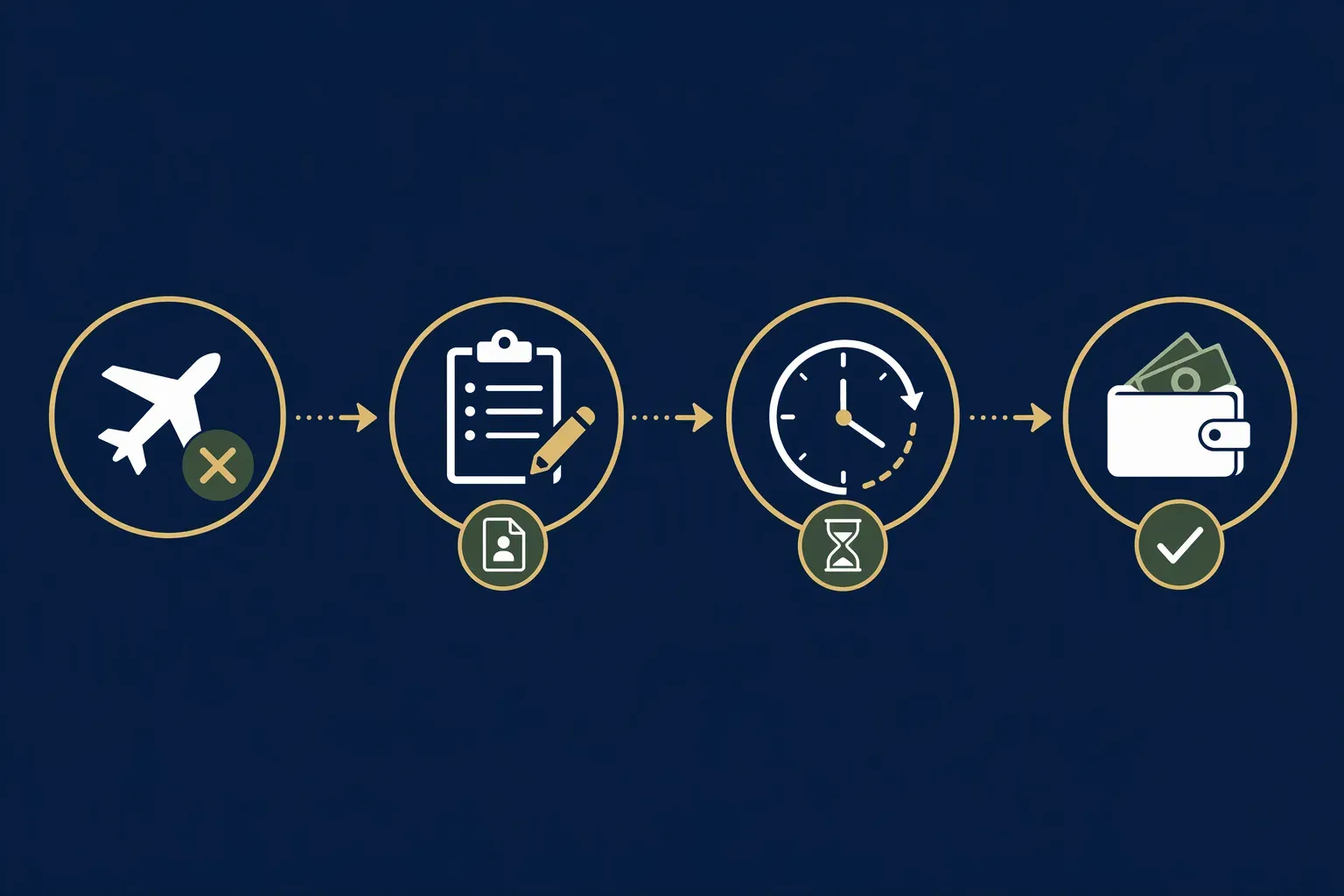
A quick step-by-step checklist
If your flight was cancelled or significantly delayed and you want a refund, here's what to do:
- Decide not to travel. You're entitled to a refund if you reject the airline's rebooking or alternate flight offer.
- Request the refund immediately. Call the airline, use their online refund form, or ask an agent at the airport. Say clearly that you want a refund to your original payment method, not a voucher.
- Get a confirmation number. Write down or screenshot the reference number for your refund request and the date you filed it.
- Wait the required timeline. Seven business days for credit-card refunds, 20 calendar days for cash.
- Follow up if you don't receive it. Email or call the airline with your confirmation number and ticket details.
- Escalate if the airline refuses. Cite the DOT rule (14 CFR 259.5), file a DOT complaint, or dispute the charge with your credit card.
For more on your rights during cancellations and delays, see Sky Stuck's guide to flight disruptions.
Need help navigating a flight disruption?
Visit the full Sky Stuck guide for step-by-step information on what to do when your travel plans go wrong.
Visit Sky Stuck Guide